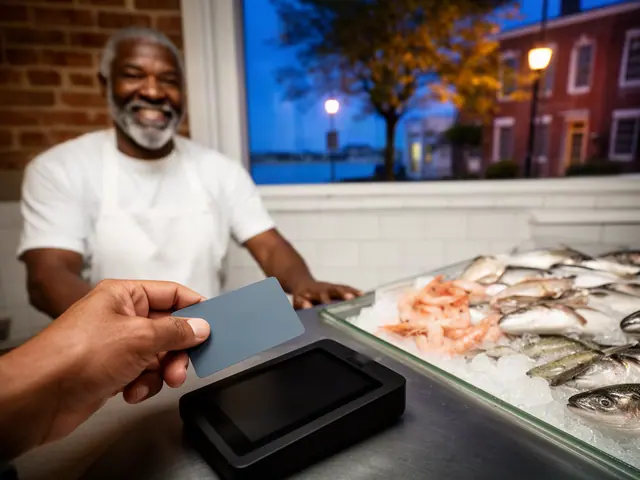
This Canyonshire Lenders page explains merchant cash advances for Portsmouth, Virginia restaurants, stores and other card-heavy businesses: how an advance is collected, how it differs from revenue-based financing, and how to read its total cost.
At a glance
- Restaurants and other eating places, Portsmouth, VA
148 employer establishments, 2,351 paid employees (CBP 2023)
- Retail trade employers, Portsmouth, VA
258 establishments (CBP 2023)
- Convenience stores, Portsmouth, VA
31 employer establishments (CBP 2023)
How an Advance Against Card Sales Is Collected in Portsmouth, VA
With an advance, the provider and the business agree on three numbers: the amount paid to the business, the total the provider will collect, and the holdback, the share of each card batch the provider keeps until that total is reached. The ratio between the total and the amount is often called a factor rate. Because the provider collects a share of sales rather than a fixed payment, a slow week means smaller collections and a busy week means larger ones.
This is also why it is not a loan. There is no interest rate and no maturity date in the loan sense; the cost is fixed when the agreement is signed, and the time it takes to collect depends on sales. That makes it fit businesses with steady daily card volume, such as restaurants and convenience stores, better than businesses paid by invoice or claim.
Revenue-Based Financing vs. a Merchant Cash Advance for Portsmouth, VA Child Care Providers
Both products rise and fall with sales, yet their mechanics differ in what they measure and how they collect. Revenue-based financing is usually a financing agreement that takes a percentage of total monthly revenue, from all channels, until a set multiple is reached. A merchant cash advance buys future card receipts and collects from card batches. A child care center that collects tuition by bank draft and subsidy payments may have little card volume, which makes an advance a poor match.
A center with uneven monthly revenue may find a business line of credit or working capital loan more predictable to budget for. The child care page covers what those products pay for.
What Is a Cash Advance Business? What It Means for a Portsmouth, VA Grocery Store
A "cash advance business" in this sense is a provider that buys future card sales from merchants. For a grocery store, the appeal is that collections shrink in a slow week, and the store does not need to pledge equipment. The cost is that the total collected is fixed at signing, and with a high holdback the daily take can squeeze the cash the store uses to pay its vendors.
Portsmouth, VA had 46 grocery store employers in 2023, including 31 convenience stores (County Business Patterns). A store looking at an advance can compare it with inventory financing for stock and a credit line for vendor bills before choosing.
How Does a Cash Advance Business Work? A Portsmouth, VA Daycare Center Example
Illustration only, invented figures: a daycare center that takes tuition by card receives a $30,000 advance with a factor rate set at 1.32, so the provider will collect $39,600 in total. With a 12% holdback and $2,800 a day in card receipts, the provider collects $336 a day, and the total is reached after about 118 card days (our arithmetic). If card receipts drop to $2,000 a day, collections fall to $240 and it takes about 165 card days in this invented example.
Either way the provider collects the same invented $39,600. That fixed total is the number to compare with the total cost of any loan or credit line offered for the same need.
How Does Revenue-Based Financing Work? A Portsmouth, VA Retail Store Example
A retail store using revenue-based financing agrees to share a percentage of monthly revenue until it has paid a set multiple of the amount received. In a strong month the payment is larger and the agreement ends sooner; in a weak month the payment is smaller. The structure looks similar to an advance, but revenue-based financing is a financing agreement measured on all revenue, while an advance collects from card batches only.
Retail had the most employer establishments of any sector in Portsmouth, VA in 2023, 258 (County Business Patterns). The retail page covers holiday stock and fixtures, which may suit other products.
Revenue-Based Financing for a Small Business in Portsmouth, VA, Used for Holdback Percentages
The holdback percentage decides how much of each day's card sales the provider takes. A higher holdback means a shorter collection period and less cash left for the business each day; a lower holdback means a longer collection period. Revenue-based financing uses a similar percentage on total revenue. The percentage and the total to be collected are both set at signing.
Before agreeing, run the holdback against a slow week, not an average one, and check whether the remaining cash still covers payroll and vendors. If it does not, the advance creates a new gap rather than closing one.
Merchant Cash Advance or Revenue-Based Financing for Portsmouth, VA Convenience Store Owners?
Convenience store owners see steady card volume from fuel, drinks and snacks, which is why advances are offered to them. Revenue-based financing measures all revenue, including cash sales, which a store with a large cash share may prefer if the percentage is lower. Neither is better in general; the right choice depends on the card share, the percentage and the total each one collects.
Portsmouth, VA had 31 convenience stores and 32 gasoline stations with paid employees in 2023 (County Business Patterns). The gas station and convenience store page covers station purchases and dispensers.
Reading the Total Cost of a Card-Sales Advance Before Signing
An advance's cost is the difference between what the provider collects and what the business receives, plus any fees. In the invented example above that is $9,600 on $30,000 (our arithmetic). Because the collection period varies, the cost cannot be read as an annual rate directly; comparing it with a loan means looking at the total dollars and how long the money is actually used.
The agreement should state plainly that a merchant cash advance is not a loan. Read the sections on fees, what happens if card sales stop, and whether the business can switch card processors. The article on how an advance works for a restaurant walks through a slow month and a busy one. Call (757) 401-4309 with the offer in hand.
By Canyonshire Lenders · Updated